
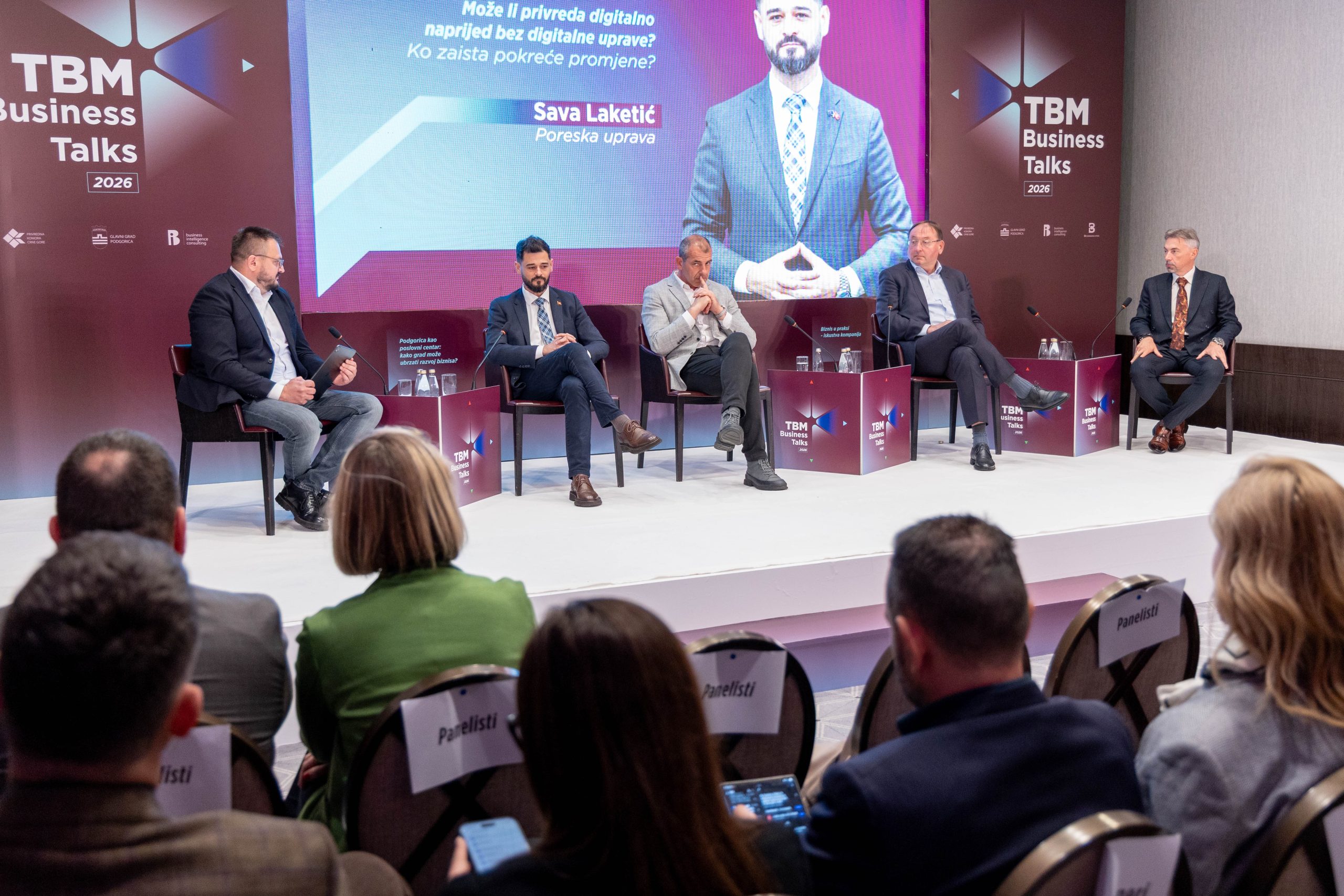
The panel moderator, Zarija Milić, member of the Board of Directors of NLB Bank, noted that according to the latest analyses, Montenegro ranks second to last in the Western Balkans in terms of the information society index.
– Currently, around 45 percent of services are digitalized, and there is still a lot of work ahead. Time is short, and I am concerned that if we do not act more decisively right away, we will put the domestic economy – especially IT companies – in a difficult position, as they will not have the resources to keep up with all projects in such a short timeframe – Milić warned.
He pointed out that 89 percent of the population has access to optical network connectivity, but that the problem remains unregulated registries and underutilized system interoperability.
– More than 50 percent of citizens are aware that e-services exist, but only eight percent use them. This shows that it is not enough to simply develop a service – citizens must know how to use it – said Milić.
Sava Laketić, Director of the Tax Administration, spoke about the new IRMS portal, designed as a fully digital model for tracking a company’s lifecycle – from registration to enforced collection. He explained that in 95 percent of business processes, visiting the Tax Administration is no longer necessary, but that a major issue remains employee resistance to automation.
– We are facing significant resistance from employees who are unjustifiably concerned about their jobs. This process has long been established across Europe, and I will not back down. The issue is both mindset and willingness. Both are moving forward, but too slowly – Laketić stated.
He emphasized that the system cannot deliver full results without complete cooperation with other institutions.
– We have situations where institutions send taxpayers back to obtain a stamp on a document that has already been electronically signed. The idea is to completely eliminate 85 to 90 percent of certificates issued last year and ensure that this data is exchanged between institutions – he said.

Dušan Polović, Director General at the Ministry of Public Administration, highlighted the cultural aspect of interoperability – the tendency of institutions to maintain control over their own data and databases.
– That is good from a security standpoint, but not if, in accordance with the Law on e-Government and administrative procedures, we do not exchange that data between registries and thereby save time for citizens and businesses – said Polović.
According to him, the Ministry has developed a digitalization plan at both central and local levels covering 171 systems.
– Last year, we fully developed 57 services. This year, we plan to develop 61 more, with the remainder to follow next year. The problem is not technology – services are used only eight percent – Polović stated.
He added that the Ministry will strengthen inspections of institutions that still insist on paper documentation.
– Digital transformation is an irreversible process. The sooner we understand that, the better it will be for everyone. There is no turning back – Polović emphasized.
Vladan Tabaš, Director of Čikom, assessed that Montenegro’s IT sector has the capacity to be a strong partner to the state, but that better cooperation and clearer systemic conditions are needed.
– In recent years, the IT sector has seen significant growth, but 2024 brought a decline – the number of companies fell by eight percent, employment dropped by 10 percent, and losses increased by 15 percent. Nevertheless, the sector has strength and is ready to work with the state to address key challenges – said Tabaš.
He particularly emphasized the importance of a meta-register and interoperability. One of the biggest challenges, he noted, is insufficient IT education among citizens, as well as among employees in the education system.
– This is where we need to focus the most. Digital transformation can only be accelerated through an evolutionary shift in mindset, where citizens use digital technologies and services to meet their needs and complete their obligations. We are moving too slowly in that area – Tabaš stated.

Zoran Milovanović, CEO of MTEL, emphasized that the telecommunications sector has already provided a solid foundation for digital transformation.
– Since its establishment, MTEL has significantly invested in infrastructure. More than 90 percent of the population is covered by the possibility of obtaining fiber connectivity. In terms of optical infrastructure, Montenegro ranks among the most developed European countries. We have laid the groundwork for everything else – said Milovanović.
He noted that the next step is connecting the telecom industry, the IT sector, the business community, and the state.
– The technology is here – we are ready to provide digital services and cooperate with the ICT community and institutions. Now we need to reach every citizen and explain how technology can make their lives easier – Milovanović concluded.

