
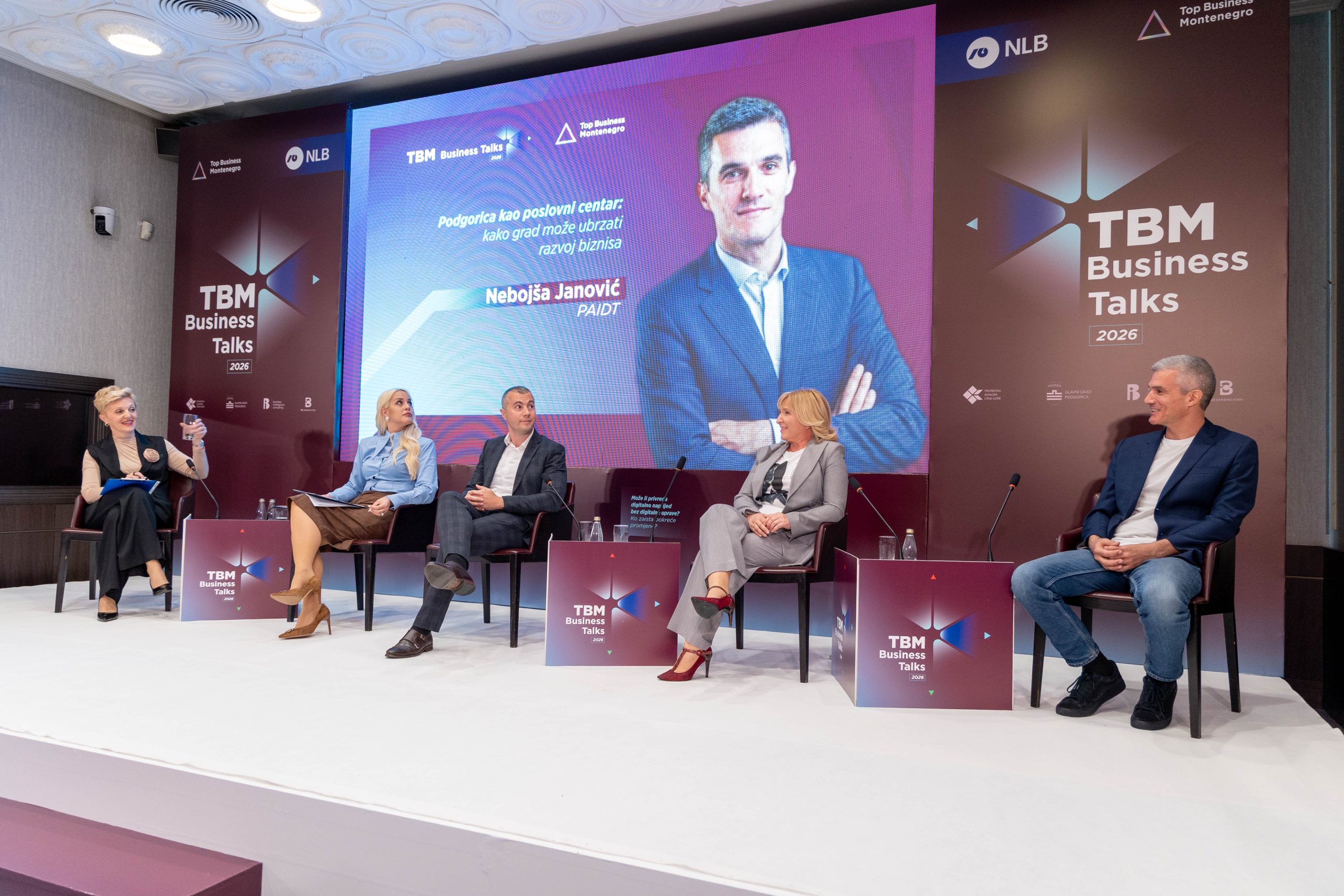
 Nađa Ljiljanić, Deputy Mayor of Podgorica, stated that the Capital City is developing a multi-layered model of business support, but that key challenges remain improved institutional coordination and a more efficient system for entrepreneurs. As she pointed out, support is implemented through direct programs aimed at specific target groups.
– We do not give aid, we provide support – for women’s businesses, the green economy, young entrepreneurs, and crafts. We have made an effort to be transparent and to have a clear activity plan so that entrepreneurs know where and how to apply – said Ljiljanić.
She emphasized that, in addition to financial support, the Capital City also offers administrative assistance aimed at simplifying procedures, but also pointed out a number of systemic issues such as unaligned registries.
– The Capital City has the highest number of registered companies, but the registries are not harmonized. Registered entrepreneurs need to be supported and informed about how they can access assistance. This has not been the practice so far – calls were announced only after certain individuals had already received funds. We must be fully transparent – Ljiljanić emphasized.
She sees the key to development in stronger cooperation between institutions.
– It is completely irresponsible toward citizens and the business sector for institutions not to cooperate. I advocate for strengthening public-private partnerships – Ljiljanić stated.
Speaking about future solutions, Ljiljanić believes there is no need to invent new models, but rather to apply proven practices from the region and Europe.
– A “one-stop shop” system should be established where investors could complete all paperwork in one place. The priority is the centralization of procedures, which would significantly ease doing business – Ljiljanić said.

Ivan Bauk from NLB Bank stated that financing support exists, but the challenge remains how to turn quality ideas into projects that banks can support. As he noted, the greatest interest from clients relates to credit support, especially in early business development stages.
– This is one of the riskier forms of financing, and it is not always easy for banks to support all the projects they would like. For this year, we have prepared a special support program of up to two million euros for young entrepreneurs – he said.
Bauk also sees a key problem in the insufficient preparedness of entrepreneurs who approach banks with good ideas that have not been developed into business plans. As he explained, such situations result in good ideas losing their attractiveness to banks.
He emphasized that there is room for stronger connections between the banking sector, institutions, and the innovation ecosystem, particularly in the context of European integration.
– EU accession will open up major funds, and we need to know how to use them – he said, noting that from a business perspective, support will always seem insufficient and slow.
Secretary of the Secretariat for Entrepreneurship Development Danijela Radeč said that the Capital City continues to expand its entrepreneurship support programs, but that key challenges remain insufficient institutional connectivity and the need for stronger mentoring support.
She recalled that multiple public calls are currently active, ranging from support for women’s entrepreneurship and crafts to rural tourism and the green economy, along with announcements of new programs for innovation.
– We have a record budget of over 450,000 euros, but it is not enough. There can certainly be more – said Radeč, emphasizing the strong interest in quality projects.

The experience of the startup “Paidt” confirms that institutional and innovation support in early development stages can be crucial for establishing a business on stable foundations, but that the biggest challenges arise in the phase of further growth and entry into the global market.
As stated by co-founder Nebojša Janović, whose company focuses on highly sophisticated stock market investing, it was precisely connections and available programs that enabled the development of their idea.
– We are an idea that grew through connections and opportunities that we would not have been able to realize on our own – he pointed out.
He emphasized that stronger financial and systemic support is crucial for the next step.
– After the initial development stages, what is missing is a springboard toward investments of one to two million euros that would push us toward the global market – said Janović.
TBM Business Talks was organized by the Top Business Montenegro initiative with the aim of offering concrete answers to the most important challenges of modern business in Montenegro through open dialogue among representatives of the business sector, institutions, the financial sector, and the IT community.

