

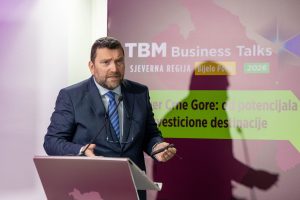
The panel moderator, TBM Chief Analyst and founder of BI Consulting Ratko Nikolić, said that the potential of northern Montenegro was undeniable, but that operating conditions and institutional support were equally important to investors as natural resources and development opportunities.
“The potential exists, and the economic gap between the north and the rest of the country definitely needs to be reduced. Achieving this will require a more strategic approach and carefully planned development,” Nikolić said.

Mayor of Bijelo Polje Petar Smolović said that, despite certain positive indicators and improvements in the business environment, he remained deeply concerned about development trends in northern Montenegro. He noted that Bijelo Polje had established six business zones, obtained a Business Friendly Certificate and become one of the municipalities with the lowest local taxes and fees in Montenegro. However, he stressed that this was not enough to generate stronger development.
“We need major investments, which the entire country currently lacks. First and foremost, we need a stable business environment. Large companies invest where conditions are more profitable, stable and predictable. Infrastructure investment must precede all private investment. We cannot expect someone to build a hotel without roads, water, electricity and sewage systems, or before the ski resort and Đalovića Cave projects have been completed,” Smolović said.
He cited Kolašin as an example, where the opening of the motorway and ski lifts launched a new investment cycle, while delays in the development of supporting infrastructure placed investors in a difficult position.
“The worst situation is a deadlock in which everything remains at a standstill while time continues to pass,” Smolović warned, adding that completing the projects already under way required considerable expertise, effective management, coordination and strong determination.
According to him, the only path towards the prosperity of northern Montenegro is through foreign investment, primarily by developing tourism and completing strategic investment projects.

Mayor of Plav Nihad Canović said that certain positive developments were visible, particularly in the improvement of public infrastructure and the growth in the number of private-sector employees and newly established companies. Nevertheless, the north continued to lag significantly behind the rest of the country.
“The indicators have improved, but we cannot be satisfied when we consider the north’s share of Montenegro’s overall economic activity,” Canović said.
He identified the lack of public investment and the absence of a coordinated national investment strategy as the main reasons for the region’s continued underdevelopment.
“The state is the largest investor. We recently heard the Prime Minister say in Parliament: ‘Follow the money.’ That clearly indicates the Government’s intentions and its approach towards the development of different parts of the country. Looking at the past five years, the money has not been directed towards the north. Construction of the second section of the motorway began six years late, while no major infrastructure project, apart from the main road between Bijelo Polje and Berane, has even been launched, let alone properly planned. Without infrastructure development, private initiatives alone are not enough,” Canović said.
He believes that local governments, with their limited budgets, cannot independently generate stronger investment momentum. It is therefore necessary for the state to direct the majority of its capital budget towards municipalities that have development potential but lack essential infrastructure.
Among the priorities of the Municipality of Plav for the coming period, he highlighted improved transport connections, the opening of the Murino–Čakor–Peć border crossing, the revitalisation and protection of Lake Plav, the development of the surrounding area and the strengthening of energy infrastructure.
Speaking about relations between local governments and the central authorities, both Smolović and Canović emphasised that northern municipalities act together through the Union of Municipalities, particularly on issues concerning decentralisation and the protection of local community interests.
The panellists concluded the discussion by presenting almost identical visions for the future of northern Montenegro. Smolović said that, within five years, he would like discussions to focus on fully operational ski resorts, their profitability and the new jobs they had created. Canović said he expected indicators confirming growth in revenue and employment, as well as an improved demographic outlook for the region.
The regional editions of TBM Business Talks will continue in September with an event dedicated to southern Montenegro. This will complete the platform’s regional concept and cover the development potential of every part of the country.

