Northern Companies Account for Just 6.36% of Montenegro’s Total Business Revenues
“Nearly 25% of Montenegro’s total net profit in 2021 was generated in the country’s northern region. “It is worth recalling that 2021 was the first post-pandemic year, demonstrating that the food production and energy sectors—both strongly represented in Bijelo Polje and Pljevlja—proved to be the most resilient industries during the crisis. This is an important indicator that should be taken into account when planning the future development of northern municipalities,” said Nikolić.
Although northern Montenegro covers 52.9% of the country’s territory, companies operating in the region account for only 6.36% of Montenegro’s total business revenues, according to the Business Performance Analysis of Northern Montenegro for the 2021–2025 period, presented by Ratko Nikolić, Founder and CEO of BI Consulting and Chief Analyst of the Top Business Montenegro (TBM) initiative.
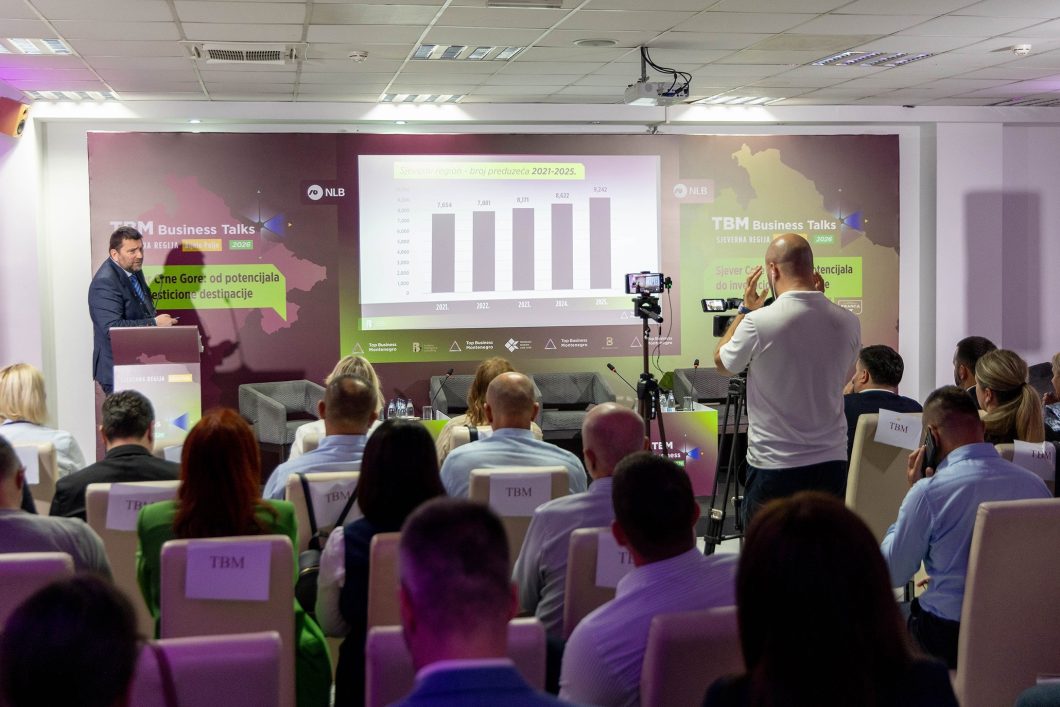
Speaking at the first regional edition of TBM Business Talks in Bijelo Polje, Nikolić stated that the data confirms the economic gap between northern Montenegro and the rest of the country has not narrowed, despite the growth in business activity over the past five years.
“Only 23.8% of Montenegro’s population lives in the northern region, yet its economic indicators remain well below even that share. The region’s share in the total number of submitted financial statements declined from 11.79% in 2021 to 10.93% in 2025, while its share of total employment fell from 10.67% to 9.55%,” Nikolić said.
At the same time, the region’s share of total business revenues decreased from 6.74% to 6.36%, while its share of Montenegro’s total net financial result fell from 24.31% to 5.98%.
“The 2021 figures represent a specific exception. Nearly one quarter of Montenegro’s total net profit was generated in the northern municipalities that year. It was the first post-COVID year, when tourism had not yet recovered, while food production and the energy sector—industries strongly represented in the north, particularly in Bijelo Polje and Pljevlja—proved to be the most resilient. This is a valuable insight for shaping future development policies for northern municipalities,” Nikolić noted.
The analysis also revealed a pronounced concentration of economic activity within the northern region itself. Nearly 30% of all registered companies are located in Bijelo Polje, while together with Berane, Rožaje and Pljevlja, these four municipalities account for almost 90% of the region’s total business activity. The remaining nine municipalities account for only around 11% of all registered businesses.
“According to 2025 data, there were 9,242 registered companies in northern Montenegro. Of these, 2,814 were registered in Bijelo Polje, 1,569 in Berane, 1,388 in Rožaje and 1,306 in Pljevlja,” Nikolić said.
He also pointed out that nearly two-thirds of registered companies do not submit financial statements.
“During 2025, a total of 3,578 financial statements were submitted, including 1,297 from companies based in Bijelo Polje,” he added.
Employment figures also confirm the dominance of the region’s four largest municipalities. In 2025, northern Montenegro employed 16,801 workers, including 5,312 in Bijelo Polje, 3,807 in Pljevlja, 3,018 in Berane, and 1,571 in Rožaje. They are followed by Kolašin, with 906 employees, while Šavnik employed 122 people, Petnjica 117, and Gusinje only 40.
“Rožaje ranks behind Bijelo Polje, Pljevlja and Berane because its economy is dominated by micro-enterprises employing, on average, fewer than two people,” Nikolić explained.
The total business revenues generated by companies in northern Montenegro amounted to €1.071 billion in 2025.
The total business revenues generated by companies in northern Montenegro reached €1.071 billion in 2025. Bijelo Polje recorded the highest revenues, with almost €400 million, followed by Pljevlja (€223.4 million), Berane (€170.8 million) and Rožaje (€106.8 million). At the other end of the scale was Gusinje, with business revenues of just €2.23 million.
“A similar pattern can be seen in net financial results. Companies in the region generated a combined net profit of €52.32 million, with Berane (€20.6 million) and Bijelo Polje (€18.9 million) making the largest contributions. Kolašin and Petnjica recorded net losses of €1.36 million and €37.3 thousand, respectively,” Nikolić said.
Although the overall indicators continue to show that northern Montenegro lags behind the rest of the country, five-year trends point to growth in business activity across almost all key indicators. However, because this growth has been slower than the national average, the region’s share in the country’s overall economic performance has continued to decline.
“The number of registered companies increased from 7,654 in 2021 to 9,242 in 2025, employment rose from 15,050 to 16,801, while business revenues grew from nearly €671.6 million to more than €1 billion. At the same time, the cumulative net financial result increased from €17.45 million to €52.32 million,” Nikolić concluded.
The TBM Business Performance Analysis of Companies in Northern Montenegro for 2025 is available for download in the attachment.